Thesis Project
Mobile
Consumer
Fighting App Fatigue (Thesis)
Dec 27, 2025

Disclaimer
This is a concise look into my thesis project. Find the entire paper Here
Intro
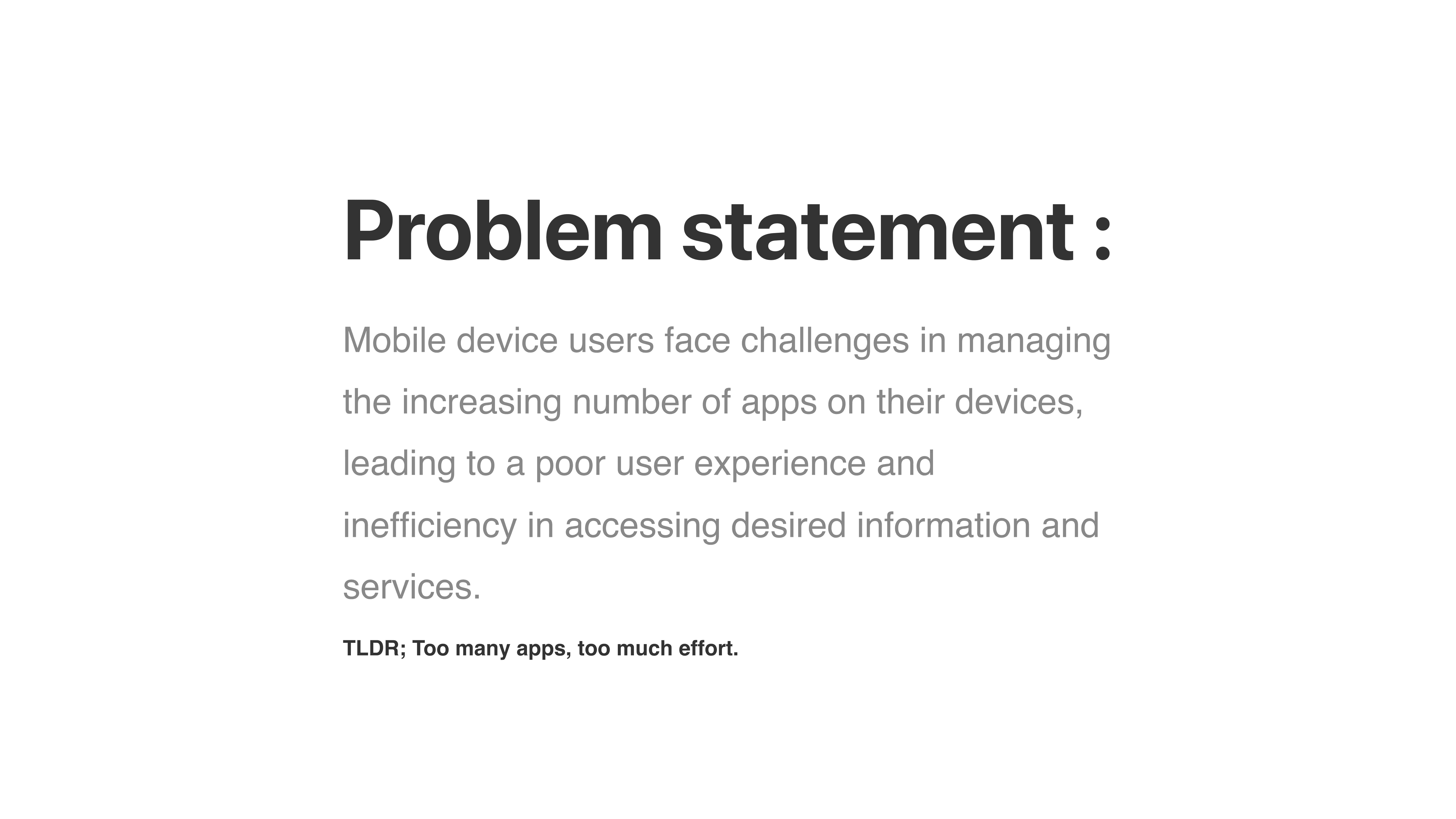
The issue of overloading applications on one's device is termed "App Fatigue".
Be it food delivery, online shopping, hailing a ride, or playing music, each app has its own USP and aims for user convenience. But isn't the app-juggling an in-convenience in itself?
PAWN sought to address this problem by centralizing the "how and why" of app functions into one unified Progressive Web App for each application category.
Objectives and Goals
Mobile devices are super-personal. Each user has their own learned, if not habituated, way of navigating the device interface. This insight derived from the research directed the primary objective and goal of this exercise.
The Objective: Map out and stick to the current behavior patterns of mobile device users, and make sure the solution reduces user-efforts apps on the device.
The goal: conceptualize a solution that solves the user's pain point of juggling multiple apps.
Research and Insights
Primary research
The key exercise performed was collecting app menu screenshots from participants to observe how they organized/ accessed them.
A key insight: People HATE disorganized experiences.
Users either organized their apps into folders themselves or used launchers and OS features to arrange frequently used apps for convenience.
Some users went as far as having dedicated home-screen layouts to fit 3-4 of their most important apps.
Secondary Research:
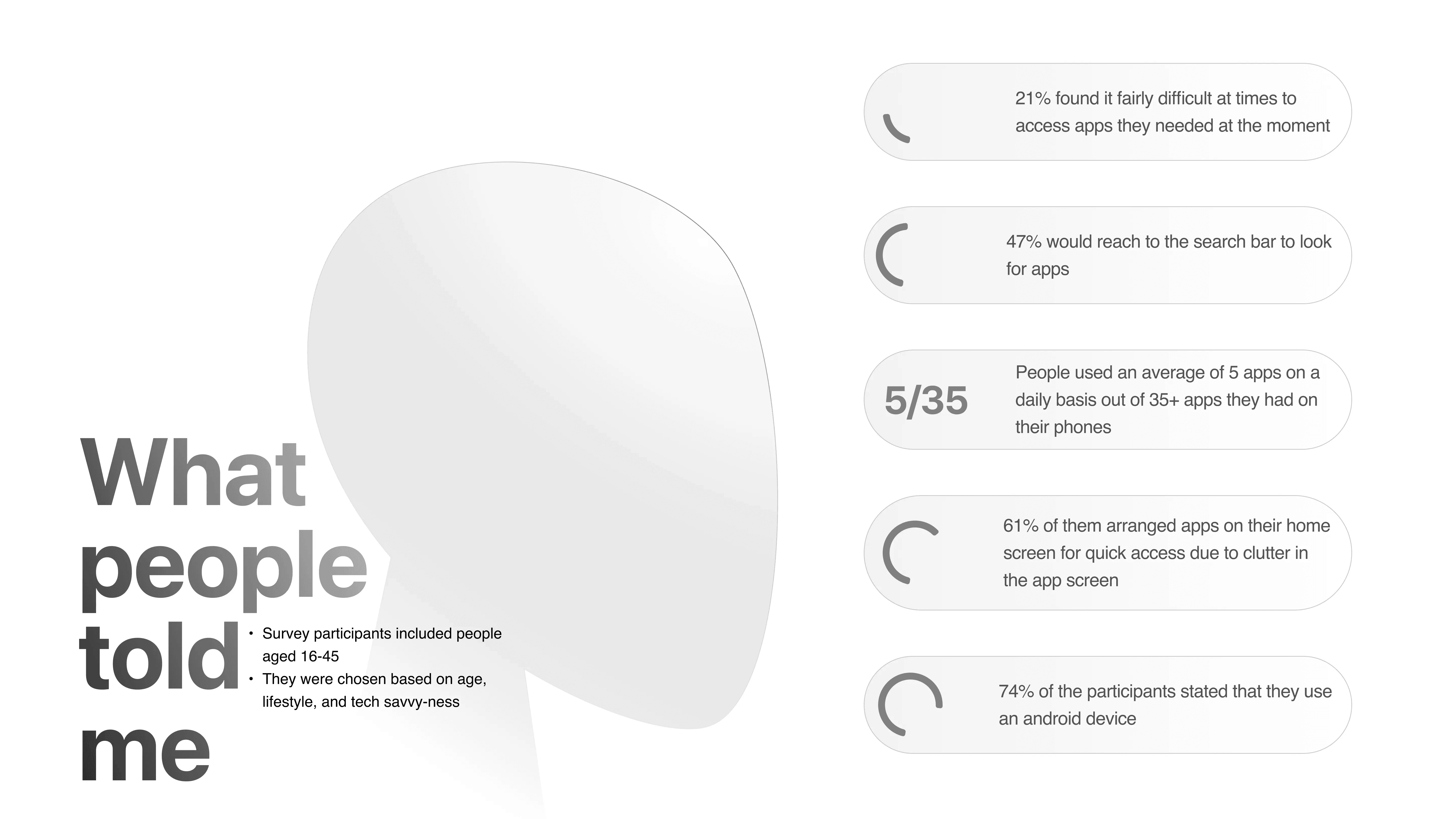
Understanding App Fatigue: Through articles, preceeding studies, and user surveys, I explored user behavior patterns, The market size of different Operating Systems, the distribution of user groups across different factors, and technological advances in the application development space.
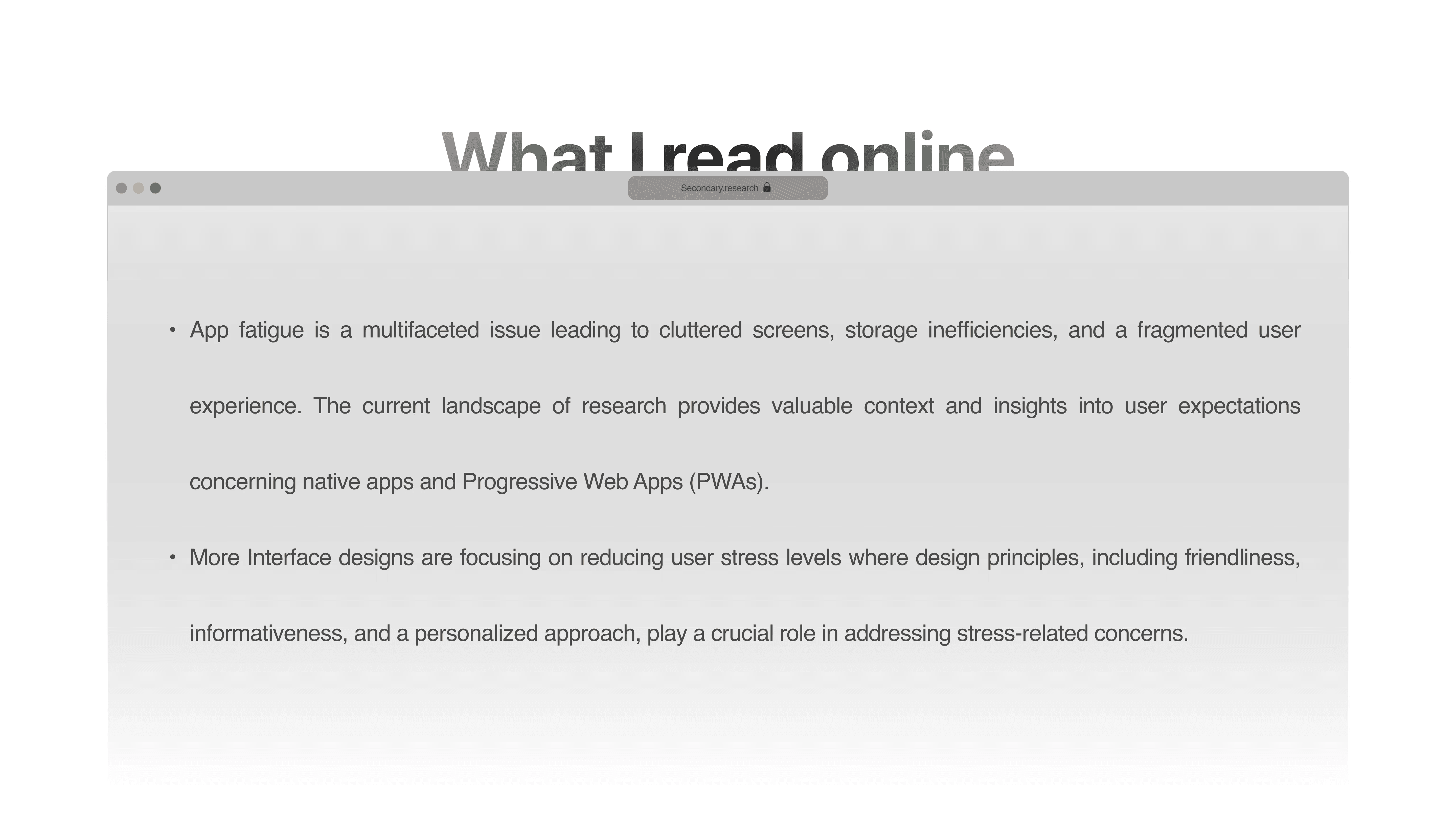
Potential of PWAs: I studied advancements in web technologies that enabled PWAs to function as efficient, lightweight, and device-agnostic platforms.
These insights informed the design approach, emphasizing simplicity, accessibility, and centralization of functionalities.
Ideation and Concept Development
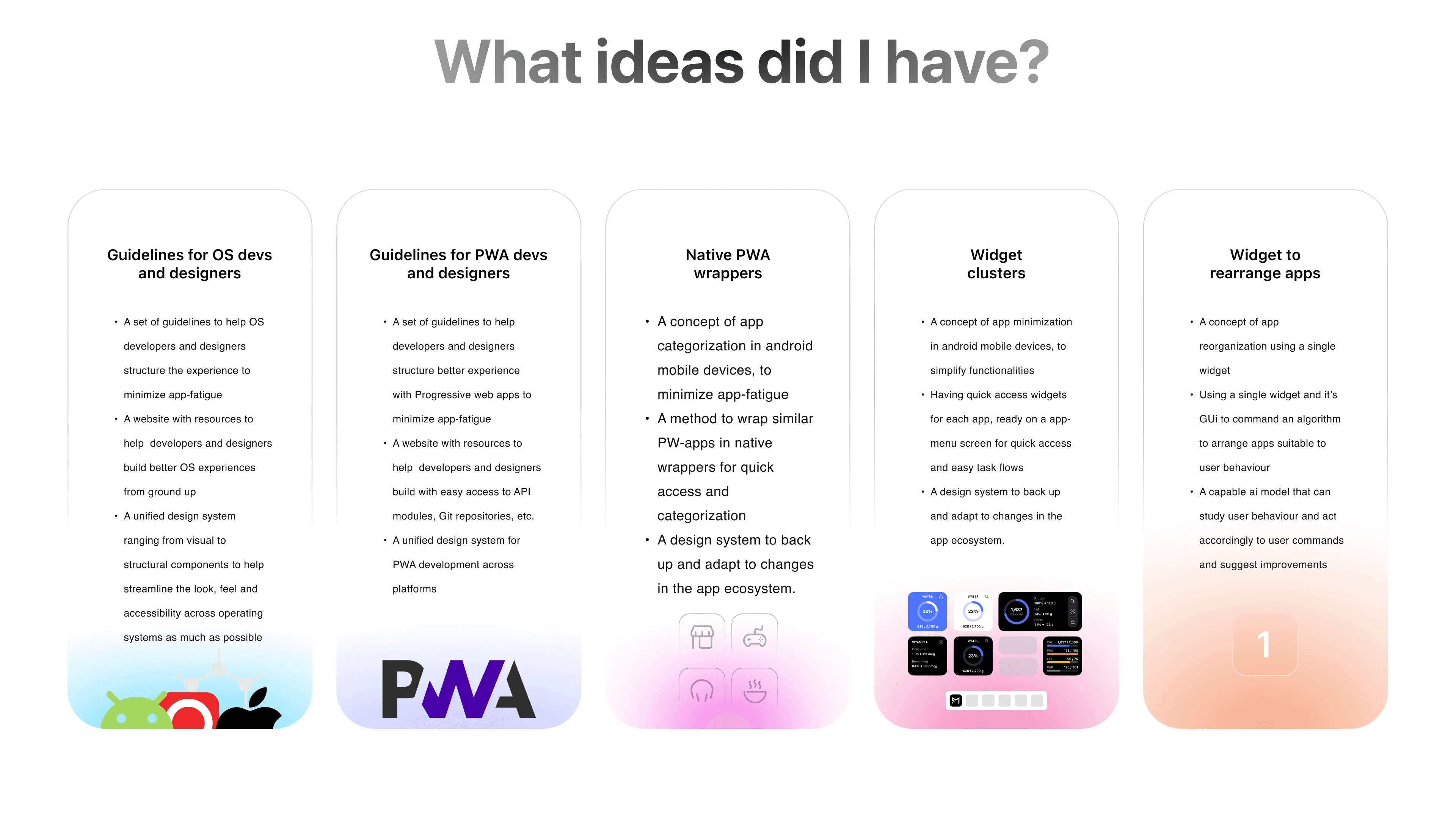
The ideation process involved brainstorming where the problem could be solved from:
At the development stage with user-centric guidelines for developers?
Through a new concept of interaction with the device?
By following existing frameworks but doing it better?
By creating a new tool/ app all over again?
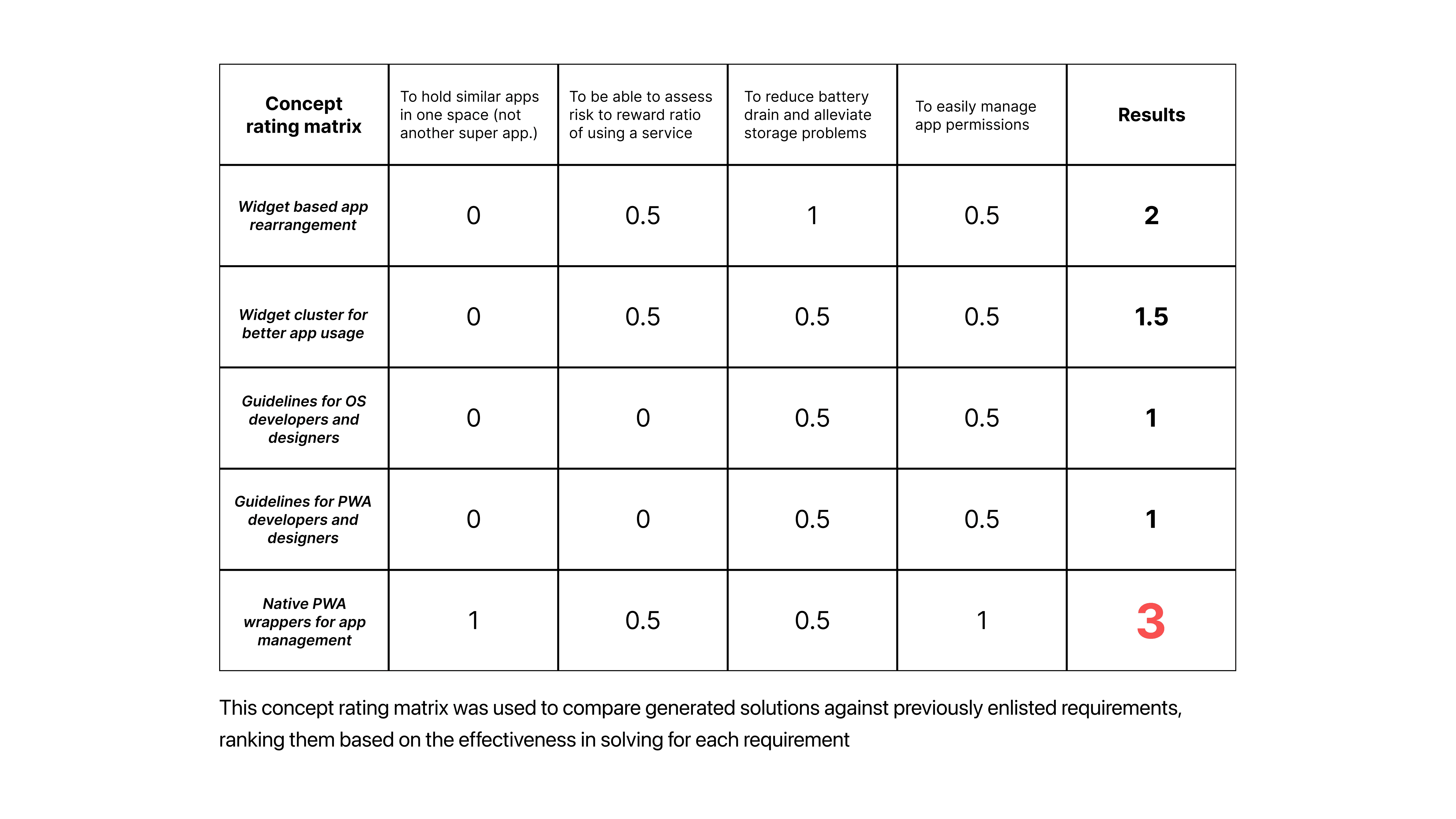
In the end, a rating matrix of the proposed solutions scored against their effectiveness across problem areas determined which solution did it best
About PWAs:
In 2015, Alex Russell and Frances Berriman recognized a new class of websites that offered a better user experience than traditional web applications, leading them to coin the term "Progressive Web Apps".
What they observed: These websites were characterized by their ability to function like native apps, offering features like offline access, push notifications, and a fast, engaging user experience.
Focus on user experience: The concept of PWAs aimed to bridge the gap between traditional web apps and native apps, providing users with a more app-like experience on the web.
Browser Support: Firefox introduced support for service workers in 2016, and Microsoft Edge and Apple Safari followed in 2018, making service workers available on all major systems.
Google's Promotion: Google then put significant efforts into promoting PWA development for Android.
Reason's for choosing to design for android only for this project:
Android having a larger user base than iOS and being easier to deploy to and customize.
73% of the participants owned android phones across different brands and showed variation in how they organized their applications
This study also performed only with the Indian demographic, where the predominant OS of choice was android
The AI Proposition
Based on the research, I also suggested a combined ML model usage framework to study user data and make the prediction of their next app/ service requirement as accurate as possible.
We called this the "Integrated Data-driven Guidance for App Fatigue"
Below is a diagram for the same:

I still am on the constant lookout for feedback on this approach as my knowledge on ML models is limited to the study I performed during this research effort and the articles I read as I come across them.
Design Process:
Wire-framing: Low-High fidelity wireframes helped map out the core user flows, functionalities and aesthetic choices. Will not bore you with the details of this.
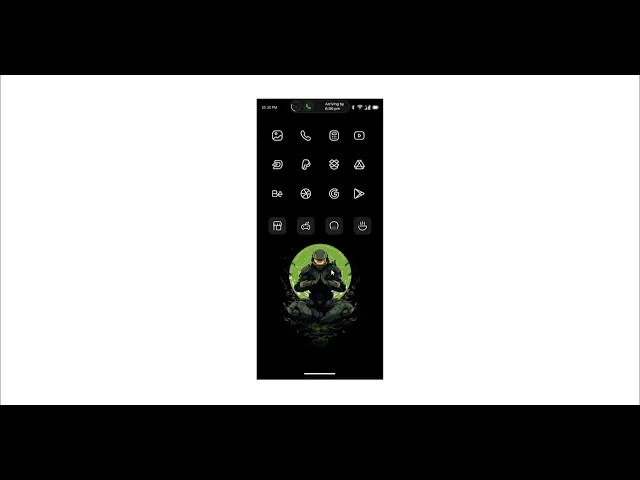
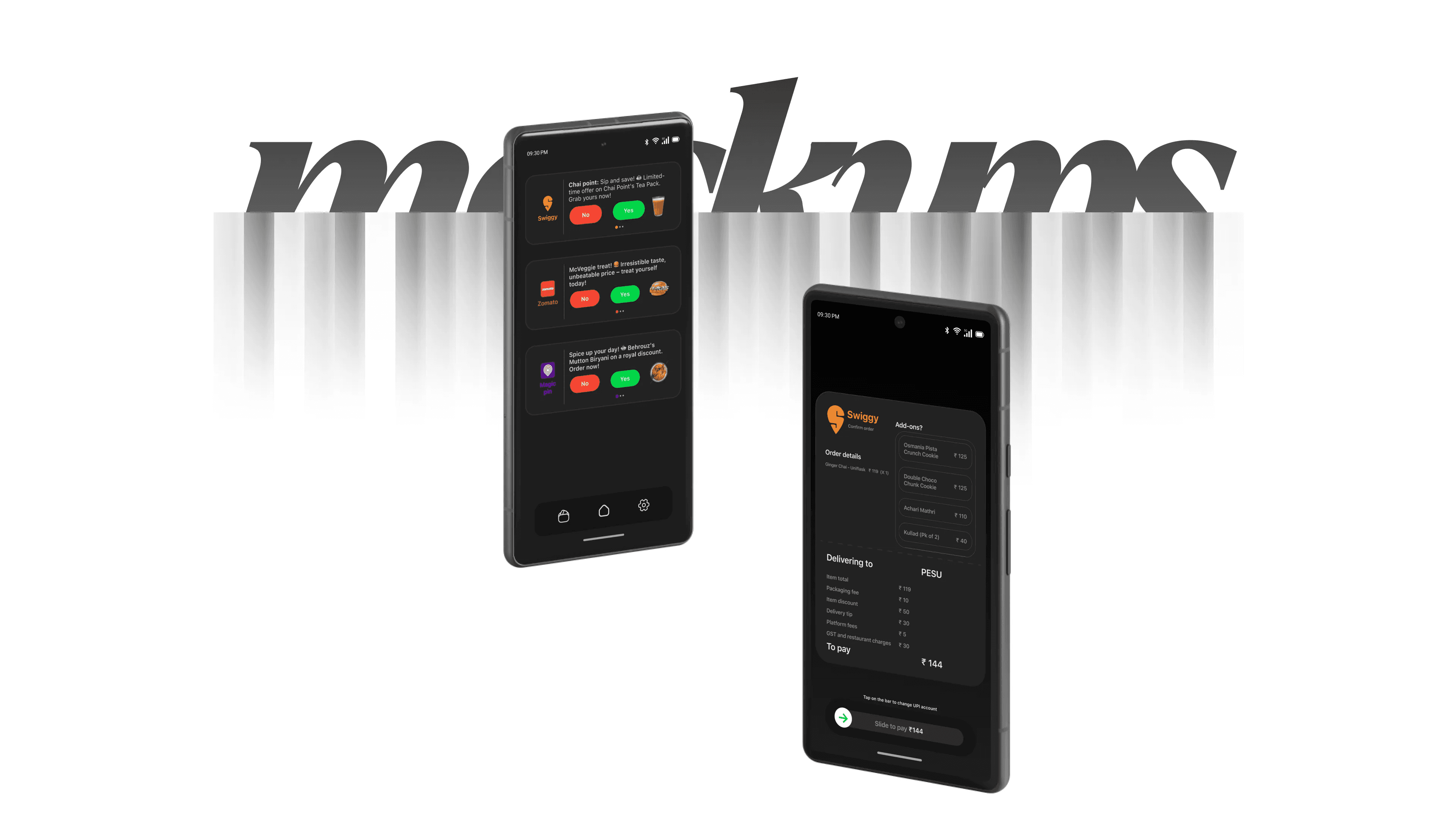
Prototyping: Created an interactive high-fidelity prototype that demonstrated how PAWN could streamline multiple app functions with a straightforward example of a food delivery scenario.

Visual Design: The design employed a minimalist aesthetic with a focus on clarity and ease of use. A consistent color palette, intuitive navigation, and responsive layouts ensured the prototype effectively communicated its purpose.
Final Outcome
The project concluded with the publication of a research paper in the ICBT journal, which highlighted the potential of PWAs as an alternative to native mobile apps.
The paper detailed the design principles, research insights, and the technological advancements leveraged in PAWN, contributing to the broader discussion on solving app fatigue through innovative and accessible web technologies.
The project received positive academic recognition and served as a strong case study for combining user-centered design with emerging technology solutions.
Learnings and Reflections
This project deepened my understanding of user-centered design, particularly in addressing complex user problems like app fatigue.
It also reinforced the importance of research-driven design and the power of iterative feedback. If I were to revisit the project
I thank my guide for pushing me to learn about ML frameworks and the math behind decision-making and predictions, which helped me propose a solution framework that sought to gain a multi-angle perspective of user behavior.